Back to: Language Through Sports – Spanish Through Football
English | Spanish
| English Explanation | Explicación en Español |
|---|---|
| Spanish uses the same basic alphabet as English, with a few unique sounds you must learn early. | El español usa el mismo alfabeto básico que el inglés, con algunos sonidos únicos que debes aprender desde el principio. |
| Mastering these sounds will help you pronounce sports terms, cities, players’ names, and stadiums correctly. | Dominar estos sonidos te ayudará a pronunciar correctamente términos deportivos, ciudades, nombres de jugadores y estadios. |
| Below is the Spanish alphabet with easy phonetic comparisons using English words. | Abajo está el alfabeto español con comparaciones fonéticas usando palabras en inglés. |
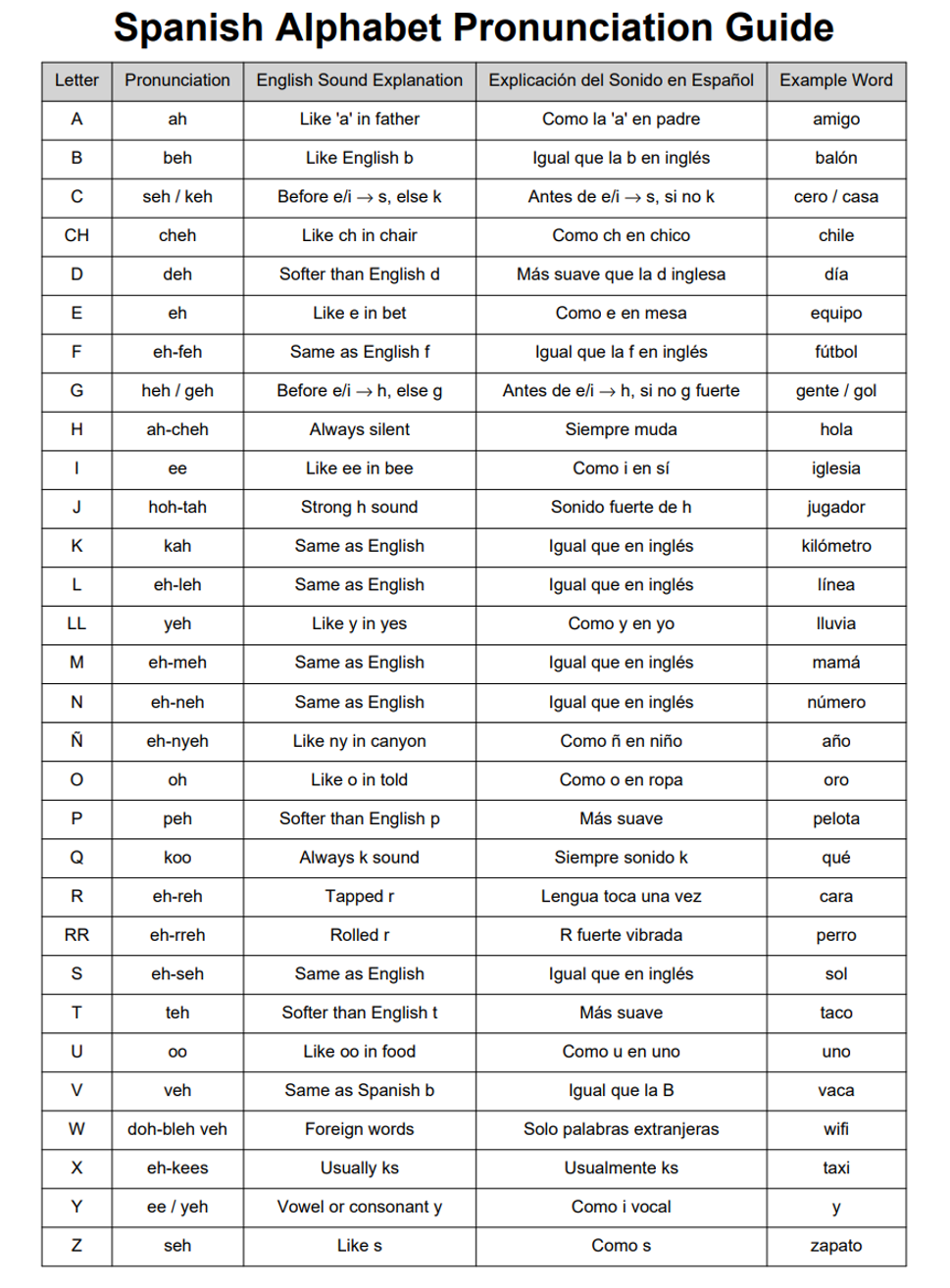
El Abecedario — The Alphabet (Conversations Only)
Maestro:
“Hoy vamos a aprender cómo suena cada letra en español. Cuando tú lees en español, todo se pronuncia exactamente como se escribe.”
English:
“Today we’re going to learn how every Spanish letter sounds. When you read Spanish, everything is pronounced exactly as it’s written.”
Maestro:
“La letra A suena ‘ah’, como en agua.
La letra I suena como bee en inglés.
La letra J siempre suena como aire saliendo — jugar, Juan, jalapeño.
La H no suena. Nunca. Hotel, hola, hijo.”
English:
“The letter A sounds like ‘ah,’ like agua.
The letter I sounds like the double ‘ee’ in ‘bee.’
The J always sounds like air blowing — jugar, Juan, jalapeño.
The H is silent. Always. Hotel, hola, hijo.”
Student:
“Entonces… ¿si yo veo una palabra, puedo pronunciarla sin ayuda?”
Maestro:
“Exactamente. Ese es el superpoder del español.”
English:
Student: “So, if I see a word, I can pronounce it without help?”
Teacher: “Exactly. That is Spanish’s superpower.”
Mini-Assignment (Fun/No Grading)
Title: Say the Alphabet Out Loud
Instructions:
“Pronounce the alphabet in Spanish out loud one time.
If you want, share a voice message in our Discord Locker Room!”
(NO submission required)
Lesson 2: Pronunciation Rules Made Easy
Objective: Learn rules for vowels, h, j, ñ, rr, c/g variations.
🟦 Spanish Lines First
“Las vocales son la clave del español.”
“The vowels are the key to Spanish.”
“Siempre suenan igual: a, e, i, o, u.” (a-ah, e-1st e of elephant, i-double e of bee, o-1st o of oreo, u-double o of boo)
“They always sound the same.”
“La ‘h’ es muda.”
“The ‘h’ is ALWAYS silent.”
“La ‘j’ suena como una respiración fuerte.”
“‘J’ sounds like a strong exhale.” (has the english “h” sound)
“La ‘ñ’ es única — como en ‘niño’.” (ny in the word canyon)
“‘Ñ’ is unique — like in ‘niño’.”
Mini Interactive Practice (No Grading)
“Try pronouncing these pairs out loud:
casa / cosa / queso(u before e or i and after g or q is silent unless it has two dots over it)
gato / gente(g before e or i is an english “h” sound)
pero / perro(to roll the double “rr” – tip of tongue behind upper teeth, slightly closed mouth, blow air out through the center of tongue)
Share in the Locker Room if you want. Optional!”
Lesson 3: Alphabet Practice — Real Words
Objective: Identify letters by sound.
Paste dialogue examples:
“Digo ‘fútbol’ — F-U-T-B-O-L.”(Accent rules – When a word ends in a vowel, stress 2nd to the last syllable. If it ends in a consonant, except n or s, stress the last syllable. If stress doesn’t follow these rules, add an accent.)
“I say ‘fútbol’ — F-U-T-B-O-L.”“Digo ‘equipo’ — E-Q-U-I-P-O.”
“I say ‘equipo’ — E-Q-U-I-P-O.”
Self-Check Quiz (Auto-Graded)
“¿Cómo suena la letra i?”
A) like “ee” in “bee”
B) like “ah”
C) silent
Correct answer: A“¿La h suena?”
A) Sí
B) No
Correct: B
Good Luck with your language through sports
Thank you very much!!! We greatly appreciate your support!!! Love you, Sis!!!